Saturday, April 28, 2012

Thursday, April 26, 2012
Proper Journal and Essay Format
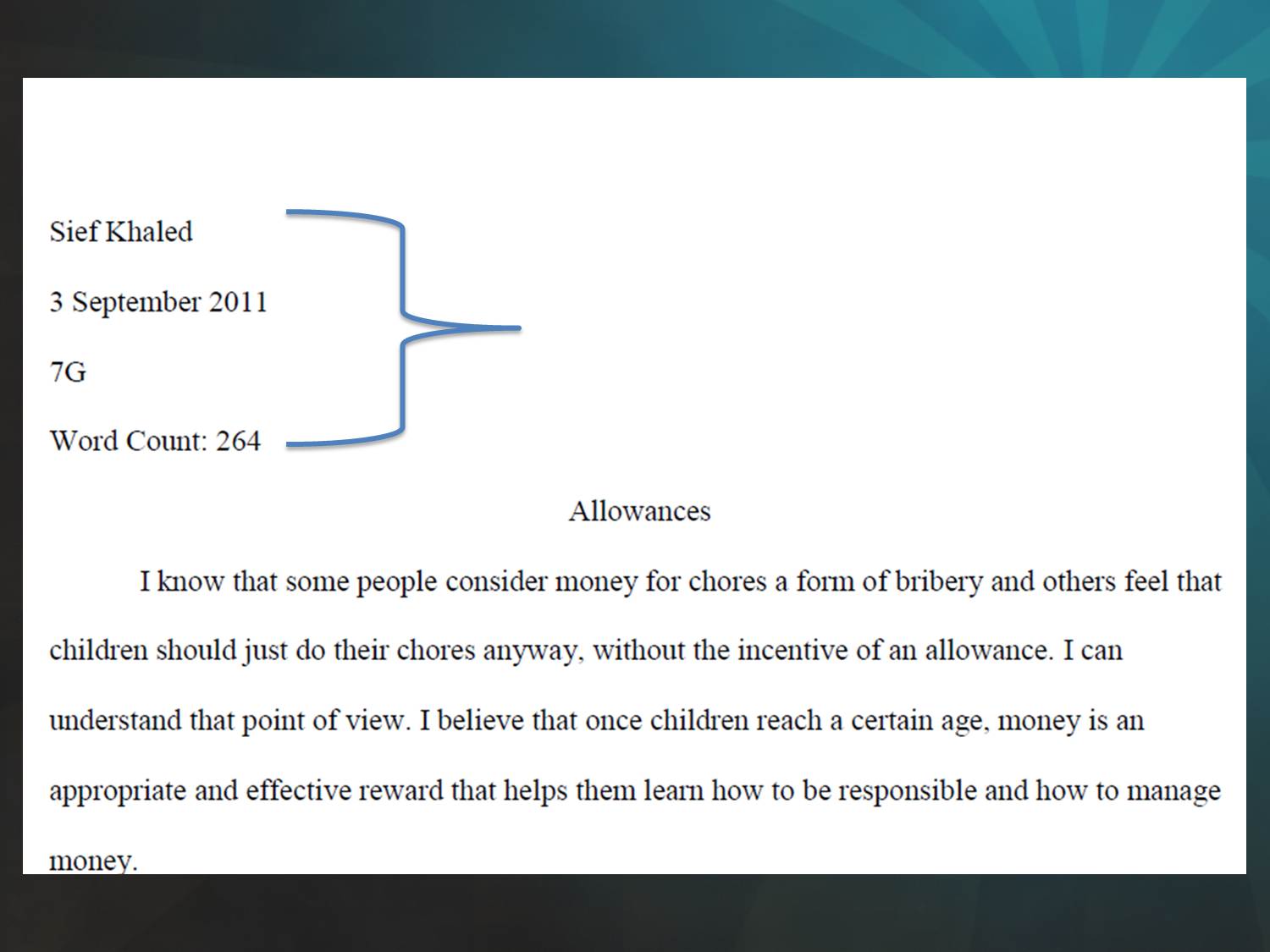
Everyone's journal/essay should look like this from a distance.

Your name, the date, class, and word count must be in the top left corner.
Go to Line Spacing Options

Choose Double under Spacing Options.

Indent Paragraph: Choose First Line by 0.5" under Special.

Make sure to center your Title. Do not make it fancy. Do not underline. Do not make it bold. Don't do anything special!

Your Journals and Essays must be in Times New Roman and 12pt font. Every single word must be Times New Roman 12pt. Nothing different!

Journal Correction Code
This is the Journal/Essay correction code; expect to see these coded abbreviations on your next journal, if you have the following mistakes.
Code
|
Description
|
NT
|
Needs Thesis in Introduction
|
RT
|
Restate Thesis in Conclusion
|
CAP
|
Capitalize first letter of sentences and proper nouns
|
IP
|
Indent Paragraph
|
SPM
|
Spelling Mistakes
|
DS
|
Double Space
|
ROS
|
Run-on Sentences
|
FRG
|
Sentence Fragment
|
TPS
|
Needs Topic Sentences
|
OT
|
Off Topic
|
NI
|
No Introduction
|
NC
|
No Conclusion
|
WRC
|
Word Count Too Low
|
NGM
|
Numerous Grammar Mistakes
|
Monday, April 23, 2012
Week 3 Information

Proposal:
Due: Sunday April 29th 2012
Vocabulary Sheet Act 3
Due: Sunday April 29th 2012
Journal:
Due: Thursday April 26th 2012
Like all tyrants, Macbeth hires thugs and villains to do his dirty work for him. Write a paragraph saying how you think Macbeth’s moral condition seems to have changed from earlier scenes.
Must be three paragraphs with at least five sentences in each paragraph.
Macbeth’s soliloquy where he highlights his plans to get rid of Banquo and Fleance to guarantee that the witches’ prophecy for Banquo fails:
Notice the language of persuasion in Macbeth’s words with the hired murderers. He is trading roles with lady Macbeth using the same techniques she has used with him earlier to convince him of killing Duncan: He questions the murderers’ manhood.
1. Lady Macbeth’s attitude towards her husband’s unhappiness and bloody desires.
2. What does Macbeth mean by: “We have scorched the snake, not killed it.”- the snake is Duncan, and his death does not secure Macbeth as king just yet, Banquo has to be killed with his son to give more security to Macbeth’s reign.
3. More on the theme of appearance vs. reality: “And make our face vizards to our hearts,”
4. Why do you think Macbeth keeps his plan of killing Duncan and his son secret from Lady Macbeth?- theme of manhood.
5. Theme of darkness (evil) vs. Light (goodness) is clear in Macbeth’s last speech.
Sunday, April 22, 2012
Thursday, April 5, 2012
Sunday, April 1, 2012
Macbeth Posters
All posters must be professionally printed and contain an image presenting a theme or image from Macbeth. No more than two students can work on each poster. Make sure to include your names on the front of the poster.
Due: Tuesday April 3rd 2012
Tuesday, March 27, 2012
Board Work

1. Setting: Inverness
2. Language of truth: compare between Banquo’s and Macbeth’s words- how would you describe each?(sharp contrast: Banquo-honest and kind words, wishes to stay free of guilt therefore he refuses to be deceived by the witches’ words- fights against evil intentions. Macbeth on the other hand lies, uses phrases such as “ a friend”,”I think not of them”- highly deceptive.
3. Supernatural happenings prior to Duncan’s death. (nature is angry- murdering of a king is an unnatural happening and therefore nature is aggressively responding)
4.“Glamis hath murdered sleep, and therefore Cawdor Shall sleep no more. Macbeth shall sleep no more.” (Important quote)
5. The porter and comic relief- an escape from the intensity of the murder scene.
6. The significance of the knocking- the gate of hell is waiting to open.(reference to Hecate- the goddess of crossroads.
7. Supernatural happenings prior to Duncan’s death. (Nature is angry- murdering of a king is an unnatural happening and therefore nature is aggressively responding)
8. The flight of Malcolm and Donaldbain
9. Macbeth elected king
10. The porter: imagines he is the porter of hell and admits three types of people: a farmer who commits suicide bec of his bad crops, an equivocator who tells half-truths and a tailor who steals cloth to make garments for himself. All three examples allude to Macbeth. Like the farmer who harvests bad crops, Macbeth schemes evil and therefore brings on his own demise(an act of suicide)Like the equivocator he tells half-truths (his love and loyalty to Duncan and his denial of thinking of the witches’ prophecies, and like the tailor he steals the throne to fulfill personal ambition. All expressed in a comic way.
11. Examples of pathetic fallacy: “the earth was feverous and did shake”
12. Example of oxymoron: “joyful trouble”
13. Dramatic irony: Macduff calling Lady Macbeth”gentle lady”
14. Breach of nature: Duncan’s murder is described in terms of a breach of nature- implying a breach in social and political order of Scotland- chaos prevails.
Literary terms:
Oxymoron: conjoining contradictory terms
Pathetic fallacy: The attribution of human emotions or characteristics to inanimate objects or to nature; for example, angry clouds; a cruel wind.
Thursday, March 15, 2012
Homework Week 6

Read until the end of act I
Journal 1 (Due: Tuesday March 20th)
Macbeth is fascinated with the witches’ prophecies, particularly with the one about him becoming king. Create your own soliloquy as Macbeth and describe your feelings about the prophecies and what they entail.
Board Work

Themes:
- ambition
- power
- Gender
- violence
- blood
- The supernatural
- Time
- Hubris
- appearance Vs reality
- light and darkness’ good Vs evil
- crime and consequence
- Betrayal
In class discussion:
In class discussion:
1. Macbeth’s fixation on the witches’ prophecies, thus changing our initial perspective of Macbeth as hero.
2. Notice the setting when the witches appear- thunder and lightning which is sinister.
3. Also notice the witches’ language of contradiction. “fair is foul and foul is fair”, “lesser than Macbeth and greater” all contradictions point to the moral dilemma of the play- similar to Hamlet’s “To be or not to be”
4. Lady Macbeth introduced through her soliloquies.
5. “Unsex me here” uttered by L. Macbeth reveals he masculine nature. (gender conflict) Though a woman, L. Macbeth understands the superiority of men and wishes to abandon her feminine nature to gain strength to pursue her objective.
5. Males vs. females, who is more evil in this play? Females (the witches and their evil nature and lady Macbeth with her evil intentions) Then males are much kinder in this play.At least Macbeth is not so intent on killing Duncan as his wife. He is therefore accused of not being “man” enough.
Sunday, March 11, 2012
Friday, October 21, 2011
Final Quiz Term 1

Our final quiz of term one is scheduled for Wednesday October 26th, 2011 and will cover:
Wordskills Unit 3
&
Language Network: Chapter 1 "Parts of a Sentence"
Please take the time to complete the Grammar Worksheet (Parts of a Sentence) this weekend to be corrected as soon as possible before your quiz.
Tuesday, October 18, 2011
Subscribe to:
Posts (Atom)